
Click on one of the physics simulations below... you'll see them animating in real time, and be able to interact with them by dragging objects or changing parameters like gravity.
Malayalam cinema is not a static portrait of Kerala. It is a living, breathing conversation. When a film like Nanpakal Nerathu Mayakkam explores the blurred identity lines between a Malayali and a Tamilian, it speaks to the borderless cultural flows of South India. When 2018: Everyone is a Hero depicts a flood devastating every religion and class equally, it reinforces the fragile, shared vulnerability of the land.
Malayalam Film Industry: History, Evolution, And Trends - Ftp
Malayalam cinema, also known as Mollywood, is a thriving film industry based in Kerala, India. With a rich cultural heritage, Kerala has been the backdrop for numerous films that showcase its stunning landscapes, traditions, and values. This report explores the relationship between Malayalam cinema and Kerala culture, highlighting the ways in which the industry reflects, influences, and preserves the state's cultural identity.
: Define the "Malayalam aesthetic"—a blend of intellectual depth and commercial viability. Mallu boob squeeze videos
To watch a Malayalam film is to spend two hours in Kerala: to smell the rain on red earth, to hear the creak of a vallam (houseboat), to feel the weight of a thousand years of history pressing down on a single decision. It is a cinema that understands that culture is not a museum piece—it is a wound that is still bleeding, a meal that is still cooking, and a conversation that is never finished.
Kerala has a unique demographic reality: a massive portion of its population lives and works abroad, particularly in the Gulf Cooperation Council (GCC) countries. This "Gulf diaspora" has profoundly shaped Kerala's economy and, consequently, its cinema.
Traditional art forms and festivals are woven into film narratives. The vibrant colors of Thrissur Pooram , the rhythmic beats of Chenda Melam , and the ritualistic performances of Theyyam and Kathakali frequently drive plots. For example, Kaliyattam adapted Shakespeare's Othello against the backdrop of the sacred Theyyam ritual of North Malabar, highlighting how ancient art forms remain relevant to contemporary human emotions. Malayalam cinema is not a static portrait of Kerala
Academic studies have explored this phenomenon, analyzing how films like Premam (2015) use food as a "semiotic device" to construct deeper ideologies around love, masculinity, and desire. The famous red velvet cake scene in Premam , for example, is credited with popularizing the dessert across South India. This cinematic focus on gastronomy reflects Kerala’s broader cultural identity, where food is a matter of deep regional pride and a powerful marker of community, class, and tradition.
To understand Malayalam cinema, one must understand Kerala’s literary and social reform movements of the 20th century. Kerala boasts a 100% literacy rate, a milestone built upon decades of educational and social activism. Early Malayalam cinema drew heavily from the state's vibrant literary tradition.
Malayalam cinema is not merely an industry that happens to be based in Kerala; it is an integral part of the state’s cultural consciousness. It is the medium through which Kerala has told its own story to itself and to the world—a story of deep-seated caste prejudice and powerful social reform, of breathtaking artistic heritage and modernizing anxieties, of the comfort of a sadya on a banana leaf and the journey of its people across the globe in search of a better life. As the industry continues to evolve, gaining unprecedented pan-Indian and global recognition for its bold, realistic, and deeply humanistic narratives, one thing remains certain: Malayalam cinema will always be, in its heart, a mirror reflecting the beautiful, complex, and soulful reality of God’s Own Country. When 2018: Everyone is a Hero depicts a
To write a proper paper on , you should focus on how the film industry serves as a mirror to the state's unique social fabric, political history, and literary traditions. Core Themes for Your Paper
In recent years, Malayalam cinema has developed a delectable new method of storytelling: the deep focus on Kerala's distinct culinary landscape. Food, in films like Ustad Hotel or Salt N' Pepper , is never just background detail; it is central to the plot, a vessel for character development, and a metaphor for love, life, and identity. These films have left audiences craving traditional delicacies like the elaborate vegetarian sadya feast served on a banana leaf, piping hot puttu with kadala (steamed rice cake with black chickpeas), and the comforting, aromatic sulaimani chai.
Kerala is known for its pluralistic society, where Hinduism, Islam, and Christianity coexist. This religious tapestry heavily influences cinematic narratives.
In the last decade, Malayalam cinema has undergone a massive renaissance, often referred to as the "New Generation" wave. This shift has radically redefined how Kerala culture is projected to the world. Redefining Masculinity and Gender Roles
There are several ways to reproduce a particular experimental setup. The easiest way is to click the "share" button.
When the recipient clicks the URL, the EasyScript that is embedded in the URL will replicate the conditions that you set up.
See Customizing myPhysicsLab Simulations for how to customize further with JavaScript or EasyScript.
myPhysicsLab is provided as open source software under the Apache 2.0 License. Source code is available at https://github.com/myphysicslab/myphysicslab. Online documentation is available.
There are around 50 different simulations in the source code, each of which has an example file which is for development and testing. There are also downloadable versions which be used to show simulations offline (when not connected to the internet).
Most of the simulation web pages show how the math is derived. See for example the Single Spring simulation.
The rigid body physics engine is the most sophisticated simulation shown here. It is capable of replicating all of the other more specialized simulations. The physics engine handles collisions and also calculates contact forces which allow objects to push against each other.
See also links to other physics websites.
The myPhysicsLab simulations do not have units of measurements specified such as meters, kilograms, seconds. The units are dimensionless, they can be interpreted however you want, but they must be consistent within the simulation.
For example if we regard a unit of distance as one meter and a unit of time as one second, then a unit of velocity must be one meter/second.
See the discussion About Units Of Measurement in the myPhysicsLab Documentation.
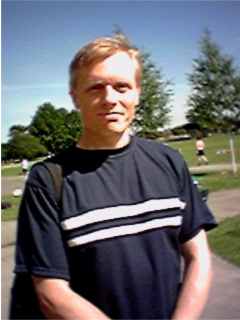
Hi, my name is , I live in Seattle, WA, USA, and I am a self-employed software engineer. I started developing this website in 2001, both as a personal project to learn scientific computing, and with a vision of developing an online science museum. I grew up in Chicago near the Museum of Science and Industry which I loved to visit and learn about science and math.
I got a BA in Mathematics at Oberlin College, Ohio, 1978, and an MBA from Univerity of Chicago, 1984. My first software jobs were using the language APL which I enjoyed for its math-like conciseness and power.
I was fortunate to get involved in the Macintosh software industry early on in 1985, joining MacroMind, which became Macromedia. I led the software development at MacroMind as VP of Engineering for 5 years. Our most significant product was VideoWorks, which was renamed Director, and lives on today as Adobe Director. In the 1980's, the interactive multimedia concepts that are so common today were new and being developed. VideoWorks was mainly an animation tool, but also incorporated programmable interactivity. Our main competitors at that time were HyperCard, SuperCard, and Authorware. Director was used in many different ways; I am most proud that it became the preferred way to prototype software user interfaces for a time during the 90's. Director was also used to develop the introductory "guided tour" tutorial that came with the Macintosh in the early years. And of course, Director was used for all sorts of art, design, and marketing projects.
I went on to work at Apple Computer on new multimedia and user interface concepts involving digital agents, animated user interfaces, speech recognition and distributed information access. In 1991, there was a sudden flurry of activity when Apple and IBM were trying to set up a strategic partnership. I became involved in the super-secret negotiations, and made the suggestion that what the world needed was a standard for multimedia that multimedia content creators could rely on to publish to (ultimately this is what HTML became). Based on these suggestions, Kaleida Labs was founded. Our work there developed a product called ScriptX, which turned out to be very similar to Sun's Java which was being developed at the same time. ScriptX had goals of supporting all forms of multimedia: text, images, audio, video, animation; being cross-platform (Mac and Windows), interpreted, object oriented, with a garbage collector to manage memory.
I then moved to Seattle and turned my attention back to mathematics and science. I relearned calculus by doing all the problems in my old college text book and took further math classes at the University of Washington. I started developing this website as a way to practice what I was learning. I am now happy to use excellent tools such as HTML and JavaScript, and leave their development to others. I continue to work on physics simulations, with several new ones in development.
Archive of older projects.
This web page was first published April 2001.